
scorpions
Protect your home or business from scorpions in Central Texas by learning about their habits, species identification and more.

Schedule An Inspection!
Click To Contact

Scorpions in Central Texas: Identification, Behavior, and What to Know
Scorpions are arachnids belonging to the order Scorpiones, making them close relatives of spiders, ticks, and mites. They are among the oldest known arthropods on Earth, with a fossil record stretching back more than 430 million years. More than 2,500 species exist worldwide, and several are established in central Texas due to the region’s warm climate, rocky terrain, and dry summers. Understanding scorpion biology and behavior is the most reliable foundation for keeping them out of homes and yards.
Scorpion Species Found in Central Texas
Central Texas sits at the intersection of the Edwards Plateau, the Balcones Escarpment, and the eastern edge of the Chihuahuan Desert influence zone – a geography that supports several scorpion species. The limestone outcroppings, cedar and live oak habitat, and hot summers create ideal conditions for scorpion activity from spring through late fall.
| Species | Common Name | Typical Size | Medical Significance | Notes |
|---|---|---|---|---|
| Centruroides vittatus | Striped Bark Scorpion | 2-3 inches | Moderate – painful but rarely dangerous to healthy adults | Most commonly encountered species in central Texas; found indoors and outdoors |
| Diplocentrus whitei | Texas Cave Scorpion | 2-2.5 inches | Low | Associated with limestone caves and rocky areas in the Hill Country |
| Vaejovis coahuilae | Coahuila Scorpion | 1.5-2 inches | Low | Less frequently encountered; found in drier western portions of the region |
The striped bark scorpion (Centruroides vittatus) is by far the most significant species for homeowners in Austin, San Antonio, and the surrounding Hill Country. According to scorpion biology and management guidance from Texas A&M AgriLife Extension, this species is highly adaptable, climbing walls, entering attics, and hiding in clothing, shoes, and bedding – behaviors that put it in direct contact with people.
Physical Description
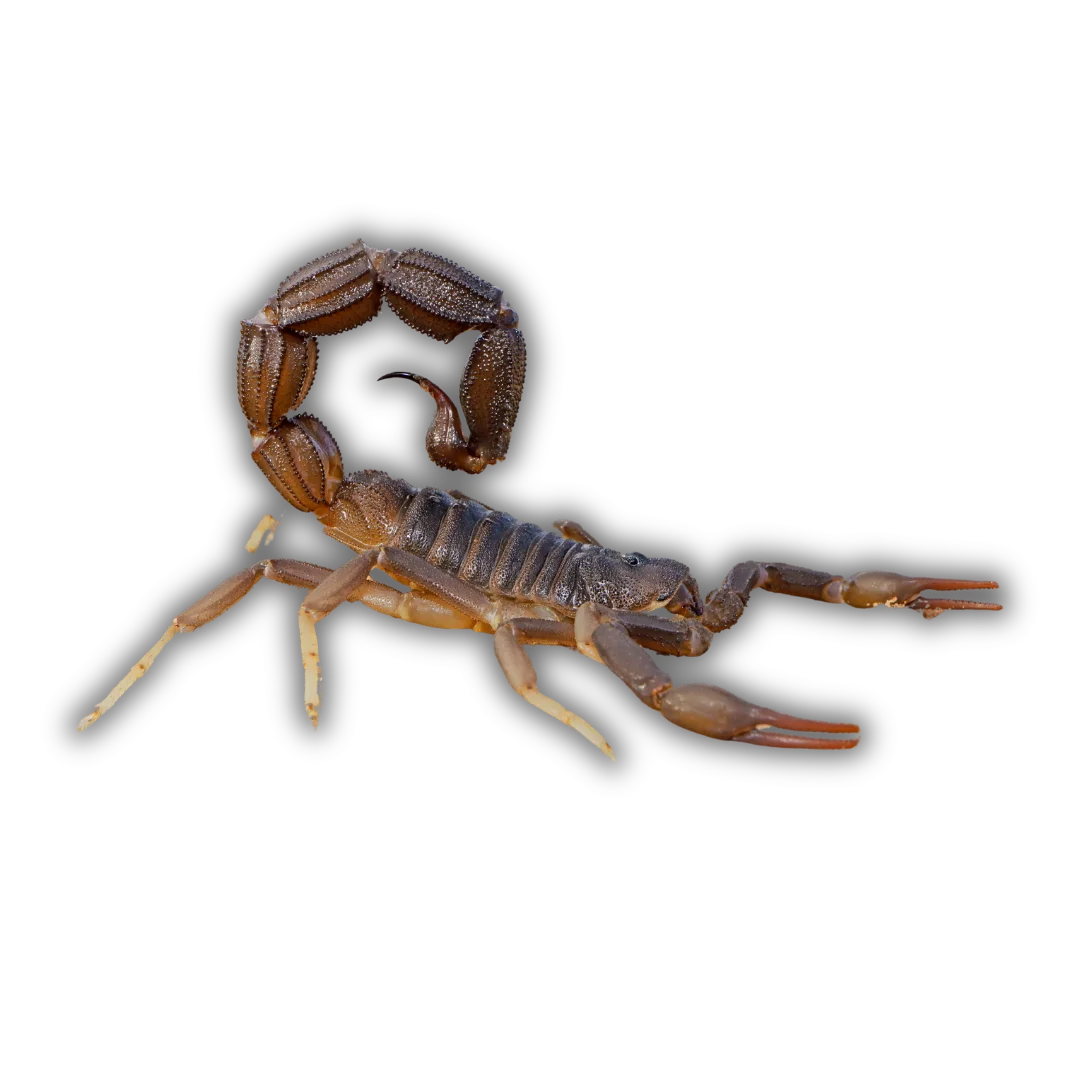
Scorpions have a distinctive body plan that makes them easy to distinguish from other arachnids. The body is divided into three main sections:
- Prosoma (cephalothorax): The head region, bearing two eyes on top and two to five lateral eyes along each side. Despite having up to twelve eyes total, scorpion vision is poor – they navigate primarily through vibration-sensing structures in their legs.
- Mesosoma (abdomen): The broad mid-section containing the digestive and reproductive organs.
- Metasoma (tail): The narrow, segmented tail that curves upward and forward, ending in a bulbous vesicle containing two venom glands and a sharp stinger called the telson.
Scorpions also have prominent pincers (pedipalps) used for capturing prey and sensing their environment. They lack bones entirely, relying instead on an exoskeleton made of chitin – similar in composition to a shrimp shell. Coloration ranges from pale yellow to reddish-brown, and size ranges from about one inch to five inches depending on the species. The striped bark scorpion is identifiable by two dark lengthwise stripes on its back and a lighter yellowish-tan body tone.
Habits and Behavior
Scorpions are solitary, nocturnal predators. In central Texas, they become most active between April and October, with peak activity during the hottest months when nighttime temperatures remain warm. During winter, they enter a semi-dormant state and shelter deep in burrows, under bark, or inside wall voids.
- Scorpions are territorial and rarely travel far from an established home range.
- They are capable of surviving without food for up to 12 months under controlled conditions, though under field conditions most feed every two to three weeks.
- They fluoresce under ultraviolet light – a UV flashlight can be used to detect them at night.
- The striped bark scorpion is an active climber and readily enters structures through gaps around pipes, doors, and rooflines, or by hitching a ride on firewood, boxes, and potted plants.
- They are strongly attracted to moisture, making kitchens, bathrooms, and utility rooms common indoor harborage sites.
Central Texas homes – particularly older limestone construction, pier-and-beam foundations, and homes backing to greenbelt or rocky terrain – face a higher baseline risk of scorpion entry due to the abundance of natural harborage adjacent to structures.
Diet and Predatory Behavior
Scorpions are generalist predators. Their diet in central Texas includes:
- Crickets, cockroaches, and other large insects
- Spiders and centipedes
- Small lizards and occasionally small mice
- Other scorpions (cannibalism is common)
Prey is captured with the pincers and immobilized with venom. Because scorpions have very small mouths and cannot chew, they secrete digestive enzymes that liquefy prey tissue, then consume only the resulting fluid. This process can take up to an hour per feeding. The presence of a high insect population around a property – particularly crickets, which are seasonally abundant in central Texas – is a reliable indicator that scorpions may not be far behind.
Reproduction and Lifecycle
Scorpion courtship is elaborate. The male and female grasp each other’s pincers and perform a movement called the “promenade a deux,” during which the male maneuvers the female over a deposited sperm packet (spermatophore) for fertilization. Males disperse quickly after mating – females will eat them if they linger.
Unlike most arachnids, all scorpion species give live birth. Key reproductive facts:
- Litter size ranges from one to over 100 offspring depending on species.
- Newborns are carried on the mother’s back until their exoskeletons harden, typically one to two weeks.
- Juveniles are venomous from birth and capable of stinging immediately.
- The striped bark scorpion matures in about six months under warm conditions.
- Average lifespan in the wild is three to five years, though some species live considerably longer.
Venom and Health Risks
All scorpions are venomous, including juveniles. However, the medical risk posed by scorpion stings in Texas is more limited than popular perception suggests. Of the more than 2,500 scorpion species worldwide, only 25 have venom capable of causing human fatalities, and in the United States, the Arizona bark scorpion (Centruroides sculpturatus) is the only species considered medically significant enough to cause life-threatening symptoms.
The striped bark scorpion found in central Texas is in the same genus but produces less potent venom. Stings are painful and can cause localized symptoms, but fatalities are exceedingly rare in otherwise healthy adults. According to sting management information from the American Association of Poison Control Centers, most scorpion stings in the United States do not require antivenom or hospitalization.
Common Sting Symptoms
- Immediate burning or stinging sensation at the sting site
- Localized pain and tenderness
- Mild swelling or numbness around the sting
- Muscle twitching in more significant envenomations
- Abdominal cramping (less common)
- Restlessness or agitation
Young children, elderly individuals, and people with compromised immune systems face a higher risk of serious reactions. Any sting involving a child under five, or any sting producing symptoms beyond the immediate sting site, warrants a call to Poison Control (1-800-222-1222) or evaluation at an urgent care facility.
Signs of Scorpion Activity
Because scorpions are nocturnal and secretive, their presence is not always obvious. Look for the following indicators:
- Direct sighting: Seeing a scorpion – especially indoors – is the clearest sign of activity. Scorpions found inside often indicate a nearby outdoor population.
- High insect pressure: Large numbers of crickets, beetles, or spiders around the foundation and landscape suggest a food source that attracts scorpions.
- Citrus or dense vegetation: Bark scorpions are frequently found sheltering in citrus trees and thick ground cover. Homes with mature citrus plantings or heavy mulch beds carry elevated scorpion pressure.
- Rocky or wooded borders: Properties that back up to limestone outcroppings, cedar brush, or creek beds – common in neighborhoods along the Balcones Escarpment in Austin and the northern Hill Country edge near San Antonio – should be inspected regularly.
- UV flashlight finds: Walking the perimeter of a home at night with a blacklight will reveal scorpions that glow bright blue-green under ultraviolet light, per scorpion detection methods documented by the University of Arizona Cooperative Extension.
Prevention: Reducing Scorpion Pressure Around Central Texas Homes
Consistent habitat modification is the most effective long-term approach to keeping scorpions out of structures. The following measures are particularly relevant to central Texas property types:
| Prevention Measure | Why It Matters in Central Texas |
|---|---|
| Seal gaps around pipes, electrical conduit, and door frames | Older Austin and San Antonio homes frequently have unsealed utility penetrations that serve as scorpion entry points |
| Remove stacked firewood, rock piles, and debris from near the foundation | Limestone rocks and cedar debris are prime harborage for the striped bark scorpion |
| Pull mulch and groundcover back from the foundation | Reduces moisture and shelter adjacent to the structure |
| Install door sweeps and weather stripping on all exterior doors | Scorpions can enter through gaps as small as a credit card’s thickness |
| Fix leaking faucets and reduce standing water | Central Texas heat drives scorpions toward moisture sources inside homes |
| Shake out shoes and clothing before putting them on | A simple personal safety habit, especially relevant during warmer months |
| Reduce exterior lighting or switch to yellow bug lights | Bright lights attract insects, which in turn attract scorpions |
The National Institute for Occupational Safety and Health guidance on scorpion exposure reinforces that physical exclusion and habitat reduction are the most reliable prevention strategies available.
Quick Reference: Scorpion Facts
| Characteristic | Detail |
|---|---|
| Classification | Arachnida, order Scorpiones |
| Number of legs | 8 |
| Average lifespan | 3-5 years |
| Maximum litter size | Up to 105 young |
| Time without food | Up to 12 months under extreme conditions |
| Activity pattern | Nocturnal; most active April through October in central Texas |
| Primary Texas species | Striped bark scorpion (Centruroides vittatus) |
| Detection method | Fluoresces under UV/blacklight |
For additional identification and biology details specific to Texas scorpion species, the Texas scorpion species checklist maintained by Texas entomological researchers provides a thorough reference. If you are dealing with a scorpion problem in or around your home, contact a licensed pest control professional for an assessment.
Our Certifications & Awards
Stride Pest Control holds QualityPro and GreenPro certifications through the NPMA's Foundation for Professional Pest Management. QualityPro represents the pest management industry's highest accreditation - often called the "Good Housekeeping Seal of Approval" for pest control - requiring background checks on all employees, drug-free workplace policies, and adherence to 16 standards that exceed state and federal requirements.
The San Antonio office operates under TPCL #827449 with Certified Applicators Alexander Randall and Raul Ramos on staff. Both hold Pest and Termite categories through the Texas Department of Agriculture. We are active members of the Texas Pest Control Association and the National Pest Management Association, with team attendance at Pest World in 2023, 2024, and 2025.
Stride maintains a BBB A+ rating for the San Antonio location with zero complaints on file.











Customer Testimonials


Danielle N.
Google Reviewer
Stacey L.
Google Local Guide
John N.
Google Local Guide
Stride Pest Control received an average rating of 4.9 out of 5 stars

based on 2,400+ reviews.
Ready For FastSafeReliable Pest Control?
You do not have to live with pests. Stride Pest Control offers same-day service across Central Texas with a satisfaction guarantee on every treatment.
QualityPro Certified | Satisfaction Guaranteed
Austin Pest Control
15305 Ginger St
Austin, TX 78728
(512) 777-1339
Stride Pest Control
1311 Chisholm Trail Rd Suite 404B
Round Rock, TX 78681
(512) 254-8185
Stride Pest Control
3501 Pin Oak Dr #110
San Antonio, TX 78229
(210) 547-8410