Austin (512) 777-1339 | San Antonio (210) 547-8410

centipedes

Protect your home or business from spiders in Central Texas by learning about their habits, species identification and more.

Spider-extermination

Schedule An Inspection!

Click To Contact

Stride Pest Control Work Truck

Centipedes in Central Texas: Identification, Behavior, and Prevention

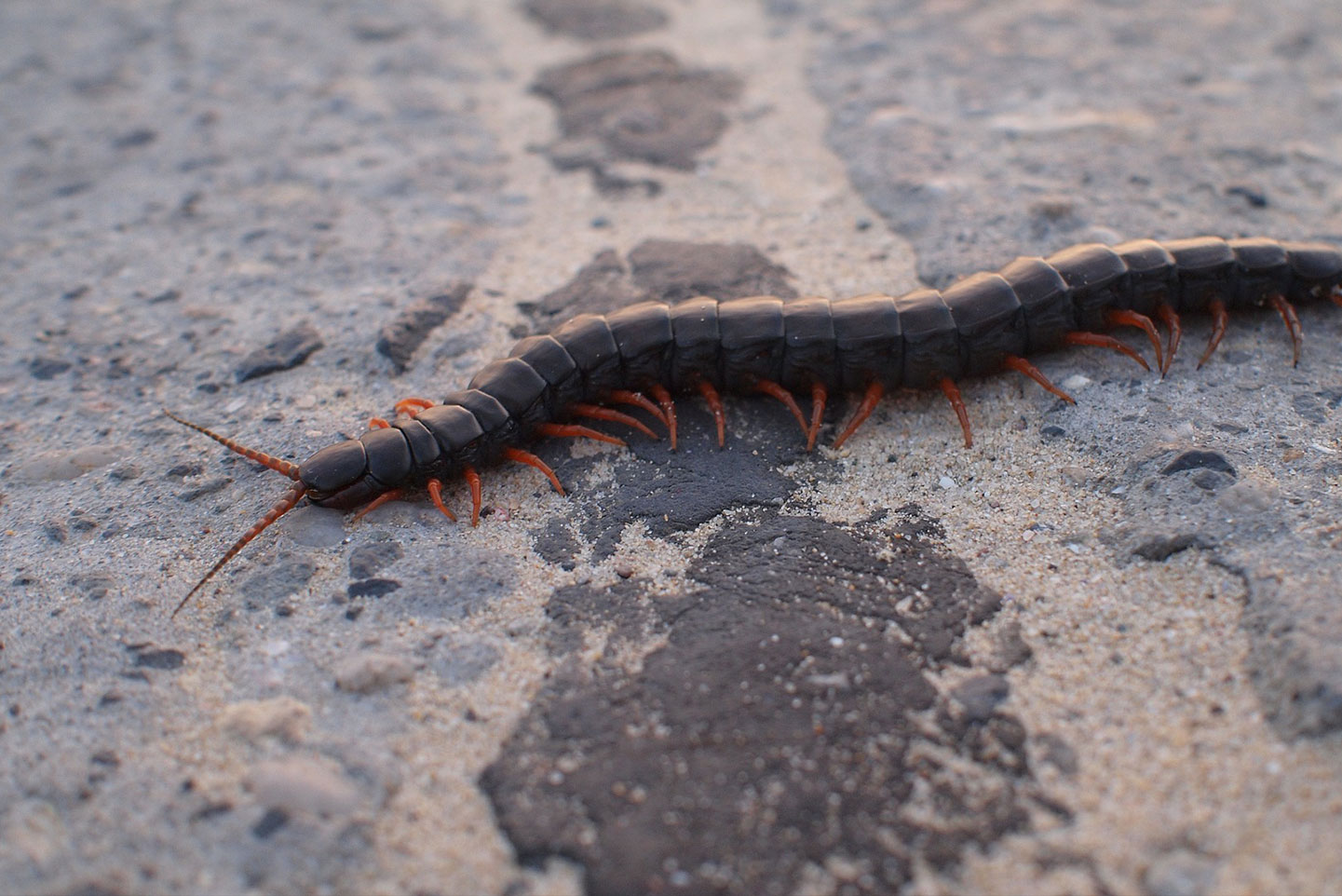
Centipede found in an Austin-area home

Centipedes are one of the more startling pests homeowners encounter in central Texas. They move fast, look unsettling, and tend to show up in the most inconvenient places – a bathroom floor at midnight, a garage corner, or along a baseboard in an older home. While they are not destructive in the way that termites or rodents are, they are a reliable indicator that other insects are present, since centipedes are active predators that follow their food source indoors.

This guide covers what centipedes are, which species are most commonly found in the Austin and San Antonio area, how they behave, and what you can do to keep them outside where they belong.

What Are Centipedes?

Centipedes are arthropods belonging to the class Chilopoda. They have elongated, flattened bodies divided into segments, with one pair of legs per segment. Despite the name, no centipede species has exactly 100 legs – leg counts range from around 30 to more than 350 depending on the species and the number of body segments.

All centipedes are venomous. They use a modified pair of front appendages called forcipules to inject venom into prey. Most species found in central Texas are not medically dangerous to healthy adults, but bites can cause sharp pain, localized swelling, and redness. Larger species are capable of breaking human skin and delivering a more significant reaction, so handling them is not recommended.

Centipede Species in Central Texas

Two species are most relevant to homeowners in the Austin and San Antonio region:

Species Scientific Name Common Locations Size Notable Traits
House Centipede Scutigera coleoptrata Bathrooms, basements, utility rooms 1 to 1.5 inches Long banded legs, very fast movement, prefers high humidity
Giant Redheaded Centipede Scolopendra heros Garages, crawl spaces, rocky outdoor areas 6 to 8 inches Bright red or orange head, black body, more aggressive, painful bite

The Giant Redheaded Centipede is the species most commonly reported in the hill country surrounding Austin and San Antonio. It thrives in the rocky limestone terrain of the Edwards Plateau, where it shelters under flat stones, cedar logs, and debris piles. According to insect identification resources from Texas A&M University, Scolopendra heros is the largest centipede species in North America and is well established throughout Texas.

Key Facts at a Glance

Fact Detail
Average lifespan (house centipede) 3 to 7 years
Leg pairs at birth 4 pairs (more are added through molting)
Eggs laid per female Approximately 63 to 150
Typical adult leg count 30 to 354 depending on species
Activity pattern Primarily nocturnal
Diet Spiders, cockroaches, crickets, silverfish, moths, and other insects

Habitat and Behavior in Central Texas

Where They Live

In the wild, centipedes prefer cool, dark, and humid environments. In central Texas, that means under limestone slabs, inside rotting wood, beneath leaf litter, and in the soil along creek beds and drainage areas. The Hill Country’s rocky terrain and the region’s mix of cedar, oak, and scrub vegetation creates abundant natural habitat for both common species.

Inside homes, centipedes gravitate toward areas that replicate these conditions. In the Austin and San Antonio area, that includes:

  • Bathrooms and laundry rooms with moisture accumulation
  • Garages and attached storage areas, especially those with clutter on the floor
  • Crawl spaces beneath older pier-and-beam homes common in central Austin neighborhoods
  • Basements, where present, and lower-level utility spaces
  • Exterior flowerbeds and landscape beds with heavy mulch coverage

Seasonal Patterns

Central Texas’s climate drives predictable centipede movement. The region’s hot, dry summers – where Austin regularly exceeds 100 degrees Fahrenheit for extended stretches – push centipedes deeper into soil or into climate-controlled structures to escape desiccation. Homeowners in the Austin metro and San Antonio area tend to see increased indoor activity in two windows:

  • Spring (March through May): Centipedes become active as temperatures rise and begin searching for food and mates.
  • Fall (September through November): Cooling nighttime temperatures drive centipedes indoors in search of warmth and shelter.

Diet and Role in the Ecosystem

Centipedes are obligate carnivores. They feed on a range of insects and small invertebrates, including spiders, cockroaches, silverfish, crickets, earthworms, and moths. This predatory behavior means a centipede inside a home is a strong signal that other pest populations are present. They do not feed on wood, stored food, or fabric – their presence is driven entirely by the availability of prey insects.

Predators and Defense

In the wild, centipedes are preyed upon by birds, lizards, toads, snakes, and small mammals. Some species are capable of releasing a sticky, irritating secretion from glands along the body as a secondary defense. When threatened indoors, centipedes will typically flee rather than confront a person, but they will bite if picked up or cornered.

Lifecycle and Reproduction

Centipede reproduction does not involve direct copulation. Males deposit a sperm capsule called a spermatophore, which the female retrieves. Eggs are laid in spring and summer, typically deposited in soil. Depending on the species, a female may lay anywhere from 10 to 50 eggs per clutch, with incubation taking one to three months.

Young centipedes hatch with a reduced number of leg pairs and gain additional segments and legs through successive molts – a process called anamorphic development. The University of Kentucky Entomology fact sheet on house centipedes provides additional detail on development stages and molt cycles.

Centipedes are notably long-lived for arthropods. House centipedes typically live three to seven years. Some Scolopendra species in warm climates like Texas can survive a decade or longer under favorable conditions.

Prevention: Keeping Centipedes Out of Your Home

Because centipedes enter homes in search of moisture, shelter, and prey, effective prevention targets all three drivers. The following measures are particularly relevant for central Texas homes, where slab-on-grade construction, cedar landscaping, and warm-season humidity all contribute to centipede pressure.

Moisture Control

  • Repair leaking pipes, dripping faucets, and HVAC condensation lines promptly.
  • Use exhaust fans in bathrooms and laundry rooms to reduce humidity.
  • Ensure gutters and downspouts direct water away from the foundation.
  • Check for standing water or saturated soil along the perimeter of the home.

Exterior Habitat Reduction

  • Keep mulch beds pulled back at least six inches from the foundation – a common issue in central Texas landscaping where thick cedar mulch is widely used.
  • Remove leaf piles, stacked firewood, and debris from areas adjacent to the home.
  • Lift and reposition any flat stones, pavers, or decorative rocks near entry points.
  • Trim ground-level vegetation that creates dense, shaded cover along the foundation.

Exclusion and Sealing

  • Seal cracks and gaps in the foundation, particularly in older Austin-area homes with limestone block or aging slab construction.
  • Apply weatherstripping and door sweeps to exterior doors.
  • Caulk gaps around window frames, utility penetrations, and pipe entries.
  • Check garage door seals, which frequently deteriorate in central Texas heat and provide a wide entry point.

Reduce Interior Prey Populations

  • Address any existing cockroach, silverfish, or spider activity, as these are primary food sources for centipedes indoors.
  • Reduce clutter in storage areas, garages, and closets where prey insects tend to shelter.
  • Store items in sealed plastic containers rather than open cardboard boxes.

The integrated pest management guidelines for centipedes from UC ANR offer a useful framework for non-chemical prevention strategies that translate well to Texas conditions.

For information on how centipede bites are medically classified, the CDC overview of venomous arthropod bites provides context on when symptoms warrant medical attention.

The Texas A&M AgriLife Extension also maintains regionally specific pest management guidance for Texas homeowners that covers centipedes in the context of local conditions and common structural pests.

If centipede activity in or around your home is persistent, it is worth having a pest professional assess what is drawing them inside. Contact Stride Pest Control at (512) 777-1339 in Austin or (210) 547-8410 in San Antonio to schedule a free inspection.

Our Certifications & Awards

Stride Pest Control holds QualityPro and GreenPro certifications through the NPMA's Foundation for Professional Pest Management. QualityPro represents the pest management industry's highest accreditation - often called the "Good Housekeeping Seal of Approval" for pest control - requiring background checks on all employees, drug-free workplace policies, and adherence to 16 standards that exceed state and federal requirements.

The San Antonio office operates under TPCL #827449 with Certified Applicators Alexander Randall and Raul Ramos on staff. Both hold Pest and Termite categories through the Texas Department of Agriculture. We are active members of the Texas Pest Control Association and the National Pest Management Association, with team attendance at Pest World in 2023, 2024, and 2025.
Stride maintains a BBB A+ rating for the San Antonio location with zero complaints on file.

TDA Texas Department of Agriculture License Lookup
Quality-Pro-Certified-Pest-Management-Logo
Associate-Certified-Entomologist-ACE-Logo
Green-Pro-Certified-Pest-Management
Entomological-Society-of-America-Certified-Corporation-Logo
Public-Health-Certified-Pest-Management
National-Pest-Management-Association-Logo
Texas-Pest-Control-Association-Logo-1
Food-Safety-Certified-Pest-Management
Round-Rock-Best-Pest-Control-2025
Schools-Certified-Pest-Management-Logo
Top-10-Best-Pest-Control-Service-in-Austin-Texas-Award

Customer Testimonials

Google Logo
5

"I’m so glad we chose Stride"

"We just moved to Texas and have never needed pest control before, so this was our first time reaching out for help, and I’m so glad we chose Stride...."
Danielle N.

Google Reviewer

Google Logo
5

"Justin was amazing!"

"Justin was amazing! We had some nasty wasps build an underground nest and he bravely moved forward with his plan. I applaud his bravery and appreciate his service!"

Stacey L.

Google Local Guide

Google Logo
5

"process was smooth from start to finish"

"Raul from Stride came out to install termite bait stations and did a great job. He messaged ahead of time to let me know he was on the way, arrived promptly, and..."

John N.

Google Local Guide

Stride Pest Control received an average rating of 4.9 out of 5 stars

based on 2,400+ reviews.

Ready For Fast Pest Control?

You do not have to live with pests. Stride Pest Control offers same-day service across Central Texas with a satisfaction guarantee on every treatment.

QualityPro Certified  |  Satisfaction Guaranteed

Austin Pest Control

15305 Ginger St
Austin, TX 78728
(512) 777-1339

Stride Pest Control

1311 Chisholm Trail Rd Suite 404B
Round Rock, TX 78681
(512) 254-8185

Stride Pest Control

3501 Pin Oak Dr #110
San Antonio, TX 78229
(210) 547-8410